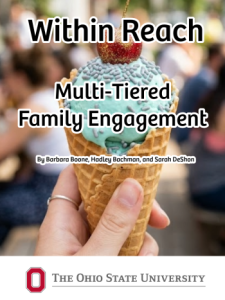
Within Reach is an interactive, open-access guide that transforms school-family outreach into authentic, data-driven partnerships reaching every family. Grounded in Dr. Barbara Boone and Dr. Hadley Bachman’s Multi-Tiered Family Engagement framework, this practical eBook delivers actionable tools, real-world examples, and reflective activities to help educators integrate evidence-based family engagement directly into their school improvement plans.
No two families are alike, so why should schools’ approach to supporting families be cookie cutter? Just like there is no one type of family, there should be no one type of family engagement plan in schools. University researchers, Hadley F. Bachman and Barbara J. Boone, argue that using a multi-tier model, which has been proven successful for academics and behavior in schools, can effectively be applied to family engagement strategies as well.
Individual and School District Variables Associated with Family Engagement in Special Education
States assess the special education services provided by each school district using various indicators, including Indicator 8, which measures how effectively school districts facilitate family engagement in special education.
State Leadership to Strengthen Family Engagement Programs
A leadership ladder model helps state, regional, district, and school leaders understand their roles in partnering with families to improve learning for students.
Creating Protective Factors in Children Through Positive Home-School Practices
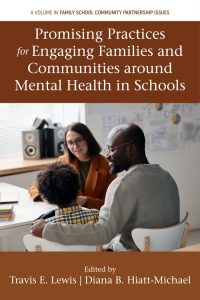
In this book chapter, we share opportunities for families and schools to partner together to promote protective factors and increase students’ resilience. This chapter describes four research-based protective factors and how to use a strengths-based, home-school partnership approach to support each. The four protective factors are teacher-student relationships, relationships at home, routines and rituals, and a sense of school belonging.
Family engagement efficacy beliefs of educators: Confirming a new
measure. Teachers and Teaching
This study explored the nature of teacher family engagement efficacy beliefs and confirmed the factor structure of a measurement instrument, the Family Engagement Efficacy Beliefs of Educators (FEEB-E). The relationships between family engagement efficacy beliefs and two other constructs, teacher efficacy beliefs and teacher trust in families, were also examined. Data from 308 teachers in two midwestern urban districts yielded positive correlations between both constructs and the FEEB-E.
Family engagement efficacy beliefs: Exploring educators’ mindsets for
building relationships with parents using the FEEB-E survey
This study explored the nature of teachers’ family engagement efficacy beliefs and developed a measurement instrument, the Family Engagement Efficacy Beliefs of Educators (FEEB-E) survey. Analysis of data from an administration of FEEB-E to 318 family-facing professionals indicated the FEEB-E items to be representative of family engagement efficacy beliefs, an adequate and reliable representation of the beliefs of the sample, without extraneous sources of variability, and, taken together, appropriate for use as a research instrument.
Centering dignitary safety in curriculum challenges: A heuristic for school administrators
Debates about what and how K-12 schools should teach young people are ongoing and may cause unrest in school communities. Regularly, school administrators face challenges to the school curriculum from students, families, and communities. Beyond legal considerations, administrators need tools to navigate relationships with the school community and maintain a safe and positive school climate for students to learn. This article proposes a heuristic based on dignitary safety–the sense of being a community member with equal standing, full rights to participation, and free from the threat of humiliation, for school administrators to evaluate the validity of curriculum challenges efficiently and consistently. We demonstrate how administrators can utilize this heuristic in addressing curriculum challenges.
Collaborating with families for innovative school mental health
In this study, a comprehensive narrative literature review is presented, examining the cross-section between family engagement and student mental health. Guided by two research questions and grounded in resiliency theory, the overlapping spheres of influence framework, and the literature on protective factors and positive childhood experiences, this study unveiled five primary themes: emphasizing the importance of educators promoting supportive relationships at home, engaging families in building teacher–student connections, collaborating to establish routines and rituals, nurturing a sense of belonging at home and at school, and fostering collaborative problem solving and self-regulation. These themes are illuminated through practical vignettes.
The role of parents during the middle school
years: Strategies for teachers to support middle school family engagement
In this article, we provide research-based strategies for middle-level educators to effectively communicate with parents to bolster developmentally appropriate family engagement. These strategies are paired with examples demonstrating how the research translates into practice.